Categories
Auto racing Drivers Formula 1 Honda Indy Racing IndyCar

Remembering Alex Zanardi

I first met Alex Zanardi on a shuttle bus in California in 2000. We, along with a group of other media people, racing drivers and race team staffers, were on our way to a Honda media event during a pre-season showcase of what was then the CART (Championship Auto Racing Teams, a precursor to IndyCar) series. At the time, the CART series was at the peak of its popularity. Zanardi had already won the CART championship twice, moved on to Formula 1 and was back in the American open-wheel racing series looking to try again with a new team.

I hadn’t planned to interview him and we’d never met before. But, since I ended sitting next to him on the ride and knew his reputation for being a funny, charismatic guy, I took the chance to throw a few questions his way.

In our short conversation he lived up to that reputation. He answered all my questions, went off on a few tangents and took a couple of good-natured jabs at some of his competitors.

It was about a year after that return to racing Indycars when he was involved in the horrific crash at a race in Germany in which he lost both legs and very nearly died.

Seemingly because he just couldn’t slow down, Zanardi eventually got behind the wheel again, driving race cars that had been modified with hand controls. And he became a hugely successful competitive Paralympian cyclist–winning four gold medals and two silver medals at the 2012 and 2016 Paralympic games, in the process becoming one of Italy’s most successful Paralympian athletes and a national hero.

Then, yet another accident halted all that. He was struck by a truck while on his hand bike during a training run in 2020. His family asked for privacy and kept largely silent about his condition while it was reported he responded well to multiple surgeries but was in the midst of a long period of rehabilitation.

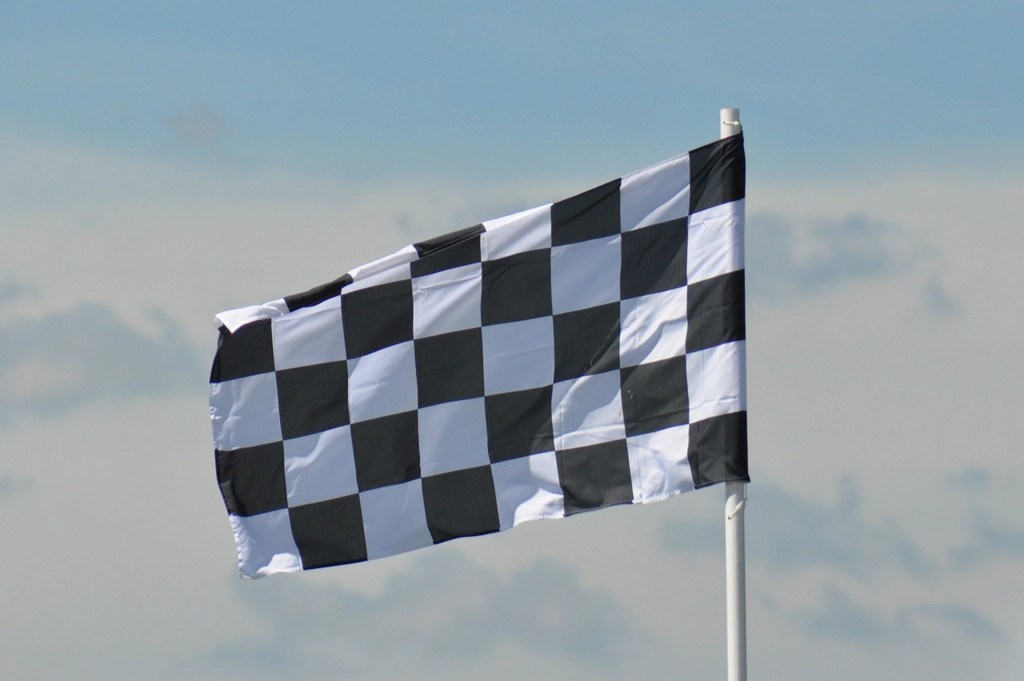
But what I remember the most about him took place about a year or so after that crash in Germany. He came to the Toronto Indy to wave the green flag to start the race, remarkable in itself given what he’d been through. I remember watching from the bleachers along the pit straightaway as he approached the flag stand, using crutches to aid with his prosthetics. He paused to wave to the crowd. We all assumed he’d wave the flag from track level because it would be too hard for him to climb the ladder up to the flag stand.

We were wrong.

He got to the stand, handed off his crutches and climbed, hand over hand, up the ladder. It took a beat or two before the crowd realized what he was doing. Many of us looked at each other as if to say “is he really doing that?” The cheering got louder as he grasped each rung and then we were all on our feet applauding as he reached the top.

That was my first thought when I found out he had died, at the age of 59. He was a relentless competitor and a case study in resilience.

His family announced his death on May 1.

Categories
Auto industry Cars Driving Honda Photography Safety

Shooting Cars: How to Capture that Perfect Auto Image

Hamin & Honda
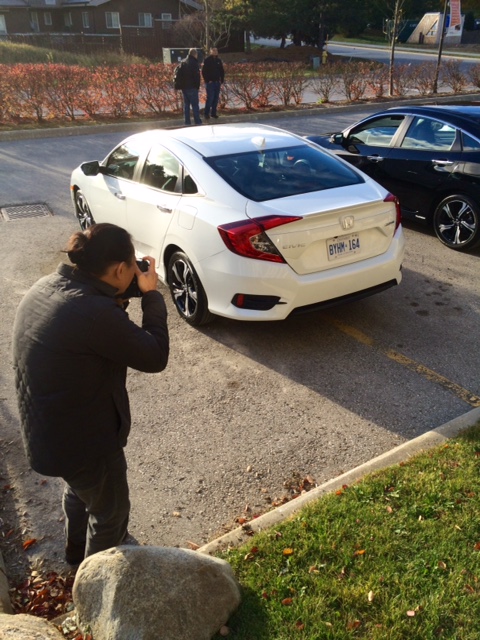
Photographer Hamin Lee shooting the 2016 Civic before our test drive

This post originally appeared on the Totem blog

Sometimes, those of us lucky enough to make magazines for a living are asked to share how we shot that image, found that story, nailed down that fascinating person for an interview.

Honestly, how we do these things is no secret, and it’s usually much less glamorous than people realize. Still, it’s often a lot of fun. Case in point: the photo shoot of the 2016 Honda Civic I was involved in awhile ago, the results of which appear in the spring issue of CAA Magazine.

Choose the right contrast to the scene

Hamin Lee, a freelance photographer and his assistant, Mark Luciani, joined me at the Civic’s launch in which journalists could try out the car in and around the Collingwood and Blue Mountain region. Mark and I each drove a car (his with a GoPro camera mounted on it) and Hamin rode shotgun with me, watching the route and scouting for places to stop and shoot. We chose white cars because they would look the best against a variety of natural backdrops, from overlooking Georgian Bay to tree-lined roads to farmer’s fields.

Keep it as safe as possible

Before we set out, we were warned (three times) to obey all traffic laws and to drive safely. It seems some of the journalists who had driven the route earlier in the week had pushed the Civic closer to the limits of its capabilities and had attracted the attention of the local police. A black and white cruiser sat conspicuously down the road from our first scheduled rest stop, visible to each of us as we pulled into the parking lot.

Don’t be shy about getting the best angle

Other than that, the most attention we received was from other drivers, many of whom slowed as they passed, watching as Hamin stood on the shoulder of the road with his camera, shooting the car on the opposite side or trying to gauge which way to place the car to catch the best light in an otherwise empty field. Shortly after, a woman in a Mercedes E-Class sedan also slowed but then pulled away abruptly in a hail of gravel, apparently unhappy that we were inadvertently blocking her entrance to the street. Later, a man in a beige Lincoln Navigator rolled passed us very slowly, eyeing us with his windows rolled down apparently wondering what three men and two white Honda Civics could possibly be doing stopped at the side of the road on such a sunny day. (The answer: trying to figure out how to place the car to shoot evergreen trees behind it, which are more appropriate for a spring magazine than the brilliant fall colours.)

Plan out your candid action shots

Then there’s the challenge of shooting a moving car. We used a few pretty simple methods. As I drove, Hamin would say, “let’s try something here.” I’d pull off the road, Hamin would get out, I’d backtrack about half a kilometre, wait for him to text me the OK and then drive past him at a consistent speed, avoiding the urge to look directly at the camera. Sometimes Hamin would point the camera from the back seat through the window and capture Mark’s car as he drove closely behind us.

But the real secret is…

The best method? The one that shows a car centred in its lane and moving at speed, appearing to come directly at the viewer, with the blacktop rushing by in a grey blur under its wheels? In the interests of maintaining good relations with the local police and not causing undue stress to my great clients, that one will need to remain a secret.

The spring issue of CAA Magazine is available now.