Categories
Auto industry Cars Driving Reviews

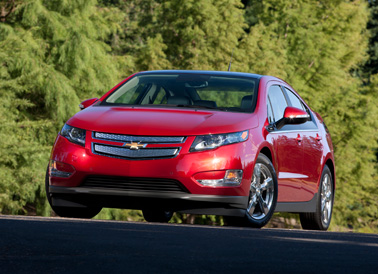
2012 Chevrolet Volt Review

Although it could be the way of the future, there’s something odd about plugging in your car. It’s like having a giant cellphone parked in your driveway, powering up. And that’s the biggest mental hurdle you need to leap when you drive a Chevrolet Volt—the way you’ve fuelled up your car since you got your driver’s license isn’t the way this machine works. Electricity is its prime propulsion method, not gasoline.

2012 Chevrolet Volt

When I first picked up the Volt from a Toronto GM dealer, I was told it was charged up and ready to go. When I got in the car, however, it was down to 20 km range on the battery (with another 360 km range in the supplemental 1.4-litre gasoline-powered engine.) After a couple stops, I was down to about 12 km on the battery.

So, on my way home, I watched as the kilometres slowly ticked down on the battery display on the dashboard. There were no warning lights or alarm bells, just a matter-of-fact ticking down of numbers, 3, 2, 1 … and then, nothing. Seamlessly, the gasoline motor kicked in and the Volt and I kept moving. Had I not been watching the dashboard display I wouldn’t have noticed much except for a change in the engine note. Once the gasoline engine started it went from being nearly silent to sounding a like a small four-banger.

Once I got home, I parked the Volt for a while and then later took it out on a few more short trips, at first feeling somewhat guilty for driving an electric car on a normal 20th century internal combustion engine. That’s when I realized what sets the Volt apart from gas/electric hybrids: the Volt’s gasoline engine doesn’t drive the wheels, it instead uses a small amount of gasoline to create electricity to keep the car going.

When I plugged it in later that evening, it took about 12 hours to fully charge via a regular 120-volt household outlet (it doesn’t have to be fully depleted before being charged up). That’s not bad, but ideally GM engineers will work to reduce that time. GM does offer an optional 240-volt recharging unit that its says can charge the car in four hours. GM also claims that the Volt can run from 40 to 80 km on battery power alone, depending on cargo and outside temperature. My review model needed charging after just under 40 km following a single day of city driving.

During those drives, however, several people stopped to admire the car, which, to GM’s credit, is a handsome machine. It’s also a cleverly designed hatchback that doesn’t look like a typical hatch. Four people can sit comfortably in front and rear bucket seats—the battery stack runs up the centre of the car, taking up some foot room and dividing the four seats. But there’s also a substantial cargo area behind the rear seats. The sloping front windshield and large rear window also provide excellent visibility. The console touch screen works well but some of the touch controls on the console can be tricky unless you hit them exactly right.

Driving the Volt is a futuristic experience. Here’s hoping GM will be able to tweak the Volt’s battery to make that experience last longer.

This review originally appeared on caamagazine.ca

Categories
Auto industry Branding Cars Driving Reviews Technology

2012 Nissan Juke Review

The 2012 Nissan Juke crosses several automotive categories

The Nissan Juke is a true crossover. At first glance it looks like a sporty, two-door coupe—until you notice the nearly hidden rear door handles. It also has the deep wheel wells and tall profile of a small, Jeep Wrangler-like SUV. And that’s the point. The Juke crosses over different car categories (compact car, crossover/SUV, sports car) to create an almost entirely new style of vehicle.

The base model SV with front-wheel drive is priced at $19,998. The Juke version I drove was the AWD model, which starts at $26,778. All four trim lines are equipped with a CVT (continuously variable transmission). Unlike CVTs on some other cars, the Juke’s is quiet and doesn’t drone at higher speeds. The 1.6-litre, 4-cylinder direct injection gas engine is turbocharged and provides strong acceleration and ample power, even in “Normal” mode. Two other engine modes are available with the push of a button on the centre console, Sport and Eco. In Eco mode, the engine’s power is reduced slightly to maximize fuel economy–perfect for a short daily commute.

The Juke’s exterior design is striking. Four headlights give the impression of two sets of eyes keeping watch on the road. Two of those eyes protrude longitudinally from above the front fenders with two circular lights below. But the design also creates some challenges. The low, sloping roofline that looks great from the outside also makes the back seat feel cramped, as does the way the cabin narrows towards the rear. A child can sit comfortably back there, but an adult would feel cramped on longer rides.

The interior design could use some work too. While the navigation/audio system is easy to learn, its buttons are small and hard to use while wearing gloves. Also, for a car that boasts such a high-tech look and is fitted with an array of toys, why are there no power adjustable seats? It seems odd to use a key fob and a start/stop button; change your driving mode with the push of a button and then resort to using a hand crank to adjust the seat. Speaking of the start/stop button, it’s located in an awkward location behind the windshield wiper stalk, making it hard to access without hunting around for it. Same goes for the switches for the heated seats. They’re located between the front seats in the centre console meaning the driver has to reach down and back to turn them on and off, taking their eyes off the road while doing so.

The rear backup camera (standard on the SL trim levels) is a great feature, even for a small car like the Juke. The cargo area is small, but is nicely concealed by the cargo cover and tinted windows.

Overall, if you’re looking for a family hauler, this isn’t the car for you. But if you’re looking for a small car that’s sporty enough to feel like a sports car with available AWD and the tall stance of a crossover, look closely into the four eyes of the Juke.

(This review was originally published on www.caamagazine.ca 01/27/12)

Categories
Branding Cars Driving

Giddy up. My new dream car is a truck

I’ve decided I want a Ford Bronco. Not the bloated monster-truck style Bronco or even the bouncy Bronco II, but the square Bronco from the mid-seventies. The one with the small tires and wheels that made it look like it was hiking up its pant legs to wade across a creek. It’s the simple design and square, rugged lines that appeal to me, and to others like newsman Chris Gailus, who, with his Bronco, was the subject of the “My Car” feature in Friday’s Globe Drive. A 1976 Bronco was even featured in the auctions section of last month’s Automobile, where a nicely restored one sold for US$37,000. And it’s also the choice of some hipsters, particularly those with a taste for classic American style and design.

I think what we all like about the Bronco are its clean lines and overall simplicity, because let’s face it, simplicity is not often found in new cars. To me, it’s a classic that’s not a classic of my father’s generation but of mine. And, like the new Range Rover Evoque, it’s a cool truck that can also be considered a really cool car.

While I still want a Porsche 911, if someone were to appear at my door and offer me a choice of a new 911 or an old Bronco, I’d take the Porsche. Then I’d sell it and buy a slightly older Porsche. Then I’d take what’s left over and buy a Bronco.

Categories
Auto racing Cars Driving Safety

Globe Drive story on La Carrera Panamericana

7 days, 100 cars, 3,000 km, one crazy race

Most people travel to Mexico to soak up the sun and enjoy some fruity umbrella drinks at an all-inclusive resort. A few others, though, come for the treacherous roads, day after day of high-speed driving followed by intense fatigue and, sometimes, the odd broken bone. And, if they’re really lucky, a trophy and a cold beer when it’s all over.

Those are the people who take part in races like Mexico’s La Carrera Panamericana, which during its heyday from 1950 to 1954, was a five-day, 2,000-mile race on public highways that was considered one of the most difficult and dangerous auto races in the world – right up there with the Mille Miglia and Le Mans.

It was intended as a way for the Mexican government to promote the completion of the Pan American highway, which was seen as a gateway to the country’s interior and its famous beaches. Over the course of five years, the list of drivers who competed in the race reads like a Who’s Who of racing legends: Juan Manuel Fangio, the five-time Formula One world champion, won the 1953 Pan Am driving a Lancia D-24; American F1 star Phil Hill placed second in the last event in 1954 with his co-driver, fellow F1 competitor Richie Ginther, driving a Ferrari 340 MM; racer turned car builder Carroll Shelby also took part, driving an Austin Healey. Porsche, whose cars raced in the 1952 and 1953 events, gave the Carrera name to many of its 911s following its success in Mexico. And the first race in 1950 was won by Hershel McGriff, driving an Oldsmobile 88. McGriff would go on to enjoy a long career in NASCAR, after pocketing $17,533 for his Pan Am win.

The Mexican government cancelled the race in 1955 – partly because it was expensive to operate and partly because it had achieved its goal of promoting road travel to Mexico. As well, as the race progressed and the cars went faster, fatalities rose. A total of 26 people – drivers and spectators – were killed in the five events from 1950 to 1954.

But, after a group of American and Mexican car enthusiasts got together in 1988, they revived La Carrera Panamericana as a staged rally for vintage cars in which drivers race against the clock for a week.

The cars don’t race at full speed for the entire time. Each of the seven days (or legs) are divided into driving stages: transit stages, which will take cars through regular traffic in cities and towns, and speed stages, which involves racing on closed highways.

The cars are timed as they compete in the stages. The winner (or winners) take home a trophy, but no prize money. This year, the race takes place from Oct. 21-27. It begins in Huatulco in the south of the country and ends in Zacateca, near the centre of Mexico and will cover a total of 3,000 km. There are about 100 entries to the race in 10 classes, according to North American co-ordinator Gerie Bledsoe. The race attracts a mix of professional race car drivers and adventurous amateur racers, people like the husband and wife racing team Tony and Lee-Ann Strelzow of Vancouver. The Strelzows – and four other Canadians – will once again tackle the gruelling course that nearly cost them their lives in 2009.

“We had a bad accident in ’09,” says Lee-Ann, matter of factly. “Our car was demolished when we went off a 100-foot cliff.”

The Strelzows were spared any major injuries, but their car, a 1965 Corvette, was badly damaged and their race was over. This year, they’ll race the same car, repaired and rebuilt, in the Historic C class, for cars made from 1955-1965 with V-8 or V-12 engines. So, why do it again? Both Tony and Lee-Ann say it’s a combination of the fast driving, racing competition, the welcoming Mexican people and the festival atmosphere that envelops the event.

“The people in Mexico are just really, really friendly,” says Lee-Ann. “When we get to some of the larger cities, thousands of people flock to the streets to the see the cars.”

The Strelzows both have substantial amateur racing and endurance driving experience – they’ve also taken part in the Targa Newfoundland, the Chihuaha Express race (in Northern Mexico) and recently returned from Paris where they bought a 1936 Bentley convertible to race in the 2013 Paris to Peking endurance race.

And while they are physically and mentally prepared, they know the Pan Am can be especially tough. “In the Chihuahua, you come back to the same hotel every night,” says Tony. “But in the Carerra you can arrive at the (end of the stage) at one or two in the morning, and you’ve been going 160 km/h all day. Then you can be back at six in the morning to start all over again.”

Competitors will typically drive eight to 12 legs of the total route during each of the seven days. A leg is about 35 km, but can take drivers up and down twisting mountain roads, past tiny villages or through crowded city streets. Still, the Strelzows have some good memories from the 2009 event. Tony recalls how during one stage their car overheated near a mountain peak and they coasted into a small town. The car was almost immediately surrounded by people who were eager to help and several ran off and happily returned with buckets of water.

“That kind of stuff happens all the time,” says Tony. “In the smaller towns and villages, it’s really a party atmosphere.”

The couple have blogged about their racing exploits as a way of keeping family and friends up to date on their whereabouts – and their safety. “A lot of people follow our blog,” says Lee-Ann. “But our friends, they think we’re crazy.”

To follow the Strelzows’ adventure online, click here

Published in The Globe and Mail’s Globe Drive on Oct. 19, 2011

Categories
Travel

Safari Style

My feature from my Kenyan safari, published in CAA Magazine. With photographers Patrick King and Tom Martin, I spent a couple of days in Nairobi before flying into the Tsavo West National Park and Finch Hattons Lodge.

Categories
Auto racing Formula 1 Indy Racing Safety Technology

Globe Drive story on racetrack designers

From Indianapolis to Daytona to Monaco, famous racetracks can take on a life and mystique of their own. How they’re designed and built can be as complicated and circuitous as the twists and turns that they make race cars endure.

Some tracks, like the Indy course at Toronto’s Exhibition Place, aren’t so much designed as simply laid out and constructed.

From Indianapolis to Daytona to Monaco, famous racetracks can take on a life and mystique of their own. How they’re designed and built can be as complicated and circuitous as the twists and turns that they make race cars endure.

Some tracks, like the Indy course at Toronto’s Exhibition Place, aren’t so much designed as simply laid out and constructed.

As vice-president and general manager of the Honda Indy Toronto, Charlie Johnstone is also the de facto track designer – he didn’t map out the track, but it’s up to him to maintain its design and update it as necessary, working closely with officials from ASN FIA Canada, the Canadian representatives of the FIA (International Automobile Federation), motorsport’s international governing body.

The first Indy-style race took place in Toronto in 1986, making this year the 25th anniversary of the race (there was no race in 2008). The 11-turn, 2.824-km (1.76-mile) track makes use of both Canadian National Exhibition grounds and city streets.

Street circuits present a unique challenge to racetrack designers in that designers need to figure out the best vantage points that allow fans to see a race, while allowing race cars to safely manoeuvre around existing buildings and other structures.

“On a street circuit, it’s not like we can build new roads, and we have to accommodate the fans,” says Johnstone. “The overriding factor becomes safety; of the drivers and the fans.”

Johnstone believes when an Indy-style racetrack was first discussed for the city in the late 1970s, initial plans called for the Lakeshore straightaway to extend to the western edge of Exhibition Place, well beyond its current location. But, says Johnstone, that would have meant an excessively long straightaway that would be great for drivers testing the red line on their cars, but not so great for fans who would have had to wait too long for the cars to make a return appearance.

An ideal time for a complete lap is between 60 and 90 seconds. (In 1999, Gil de Ferran recorded the fastest pole time registered for the track with a lap of 57.143 seconds.)

“It’s pretty unique to have a back straight like Lakeshore on a street course,” he says, especially compared to notoriously tight street courses like Monaco, which offer drivers too few passing options.

The track’s design is also inspected by FIA officials every year and if there’s wheel-to-wheel contact during a race. “We look at every accident that happens to see if we can make any improvements to the course,” says Johnstone. “The cars are analyzed, as well as the walls and fences, to make sure they’re doing what they’re supposed to do.”

The track will get some new walls and fences in time for this year’s event, partly funded by the federal government. They were redesigned to meet FIA specifications for height, thickness and weight.

“We’re the only sport that builds our stadium and tears it down every year,” says Johnstone.

Roger Peart knows all about motorsport “stadiums” such as the Honda Indy racetrack. Peart is the president of ASN Canada FIA. In addition to his work inspecting racetracks and working around the world for FIA, Peart can also lay claim to designing what became known as Circuit Gilles Villeneuve in Montreal, in 1977.

At the time, Peart was an engineer by trade and a part-time race driver. Labatt held the sponsorship rights to F1 in Canada and had decided to move the race from Mosport. Peart, who had also become involved in track safety and race officiating, took it upon himself, with Labatt’s support, to design a track on Ile Notre Dame. At the time, the Expo 67 buildings were languishing on the site and some were ready to be condemned; so Peart thought it would be a great spot for a racetrack.

But an island presents its own unique challenges.

“We had a lot of water, but not much land,” he says. “I would have liked to take advantage of the grandstand that faced the (Olympic) rowing area, but that was impossible. So we had to squeeze both directions of the track behind that grandstand.

“We ended up creating the hairpin, which has become a very popular spot.”

The track came together over just a matter of months – the design was approved in May, 1977, and the first F1 race took place in November. It received the perfect opening-day gift when Canadian Formula One star Gilles Villeneuve won the first Grand Prix on Nov. 13, 1977.

Since that time, Peart has remained active in track design and safety and became a member of the FIA Circuits Commission in 1979. All his work on track inspections hinges on safety, the definition of which has evolved from catch-fences to gravel traps to systems using sophisticated computer models.

One such system is in use by FIA. Making use of CAD drawings supplied by tracks around the world, the system can plot the ideal racing line around a particular track, using data from a selection of racing cars, with Formula One cars setting the fastest benchmark.

The system can plot the escape line of a car that has lost control and is leaving the track, mapping how far it will go before coming to a stop. “It will allow you to look at the amount of runoff room, and make modifications (to make that portion of the track safer),” he said.

Like Peart, designer Alan Wilson was a driver first and a track designer second. He also worked at the Brands Hatch circuit in the U.K. in the late 1970s, became involved in track safety, which led to track design and eventually to full-time work as a track designer. The process of seeing a racetrack from concept to design to construction can be long and difficult, yet he still gets about three requests a week to design one, and has designed about 100 in his career, with 31 tracks completed and operating.

Wilson says the requests to design a racetrack usually originate with an enthusiast or business person looking to develop a parcel of land. Often, he adds, they have “strong pre-conceived ideas” of what they want the finished project to look like.

Wilson’s first task is make a general assessment of the business aspects of the project and get a sense of the environmental impact a racetrack would have on the area – it can’t be near wetlands, for example – and he’ll look at overall terrain and identify infrastructure issues such as proximity of access to sewer and water services and ease of access for pedestrians and motorists.

From that point, he’ll try to find the flattest piece of land to situate the paddocks and the main straightaway along with the main entrance.

Tracks are typically built to accommodate a variety of racing machines, from motorcycles to vintage cars, so the main straightaway should be about 2,000 feet in length. Like other designers, Wilson keeps safety a top priority as the design begins to take shape, but he also tries to take into account harder to define elements such as where the sun will hit a driver’s eyes at a certain time of day.

Wilson designs the track with motorcycle racing in mind – cars can race on a motorcycle track because of their width and huge runoff areas. Typically, Wilson says customers will ask for one 150-mph (240-km/h) corner, and he tells then they’ll also need a 2,500-foot straightaway that will allow the cars to build up the speed necessary to take a 150-mph corner. They then also need a large safety zone and a wide radius near the turn, in keeping with FIA guidelines.

Early on in its development, a track will begin to develop its own character as the designers and their teams begin to adapt the track to the natural terrain. Wilson is currently working on a new motorsports complex in New Orleans (which will be part country club, race track and private driving facility). The terrain there is mostly flat, with some of it below sea level, which means the ground is fairly soft and it’s difficult to add weight to it.

At Calabogie Motorsports Park near Ottawa, a track he also designed (based on an old track) and which remains one of his favourites, designers and construction crews had quite a different challenge. They had to work around the rocky terrain – a turn is named Big Rock.

“At Calabogie, it’s an organic track. It’s the only one I didn’t design on a computer,” says Wilson. “The terrain was so different that I actually walked through the woods with a bulldozer behind me pointing out areas to avoid.”

Published in The Globe and Mail’s Globe Drive on June 8, 2011
Categories
Auto racing Formula 1 IndyCar NASCAR Touring Cars

Jacques Villeneuve: A Man for All Seasons

My interview with Jacques Villeneuve: former F1 world champion, CART champ and Indianapolis 500 winner.

Villeneuve interview (pdf)

Categories
Auto shows Branding Cars Marketing

Volt, Sonic star in Detroit

Some early news from the North American International Auto Show in Detroit: The Chevrolet Sonic made its debut and, to no one’s surprise, the Chevrolet Volt is the North American Car of the Year. And, the newly revamped Explorer is the truck of the year.

Categories
Auto racing Formula 1

NY Times F1 Year in Review

A story by the Times’ Brad Spurgeon on a lacklustre, yet unusual F1 season:

http://www.nytimes.com/2010/11/27/sports/autoracing/27iht-SRPRIX.html

Categories
Cars

Consumer Reports Cars Blog: Nissan releases Leaf specs, leads the NYC Marathon

Nissan releases some Leaf specs:

Consumer Reports Cars Blog: Nissan releases Leaf specs, leads the NYC Marathon.