Categories
Auto industry Cars Reviews Safety Technology

2014 Jeep Wrangler Sport Review

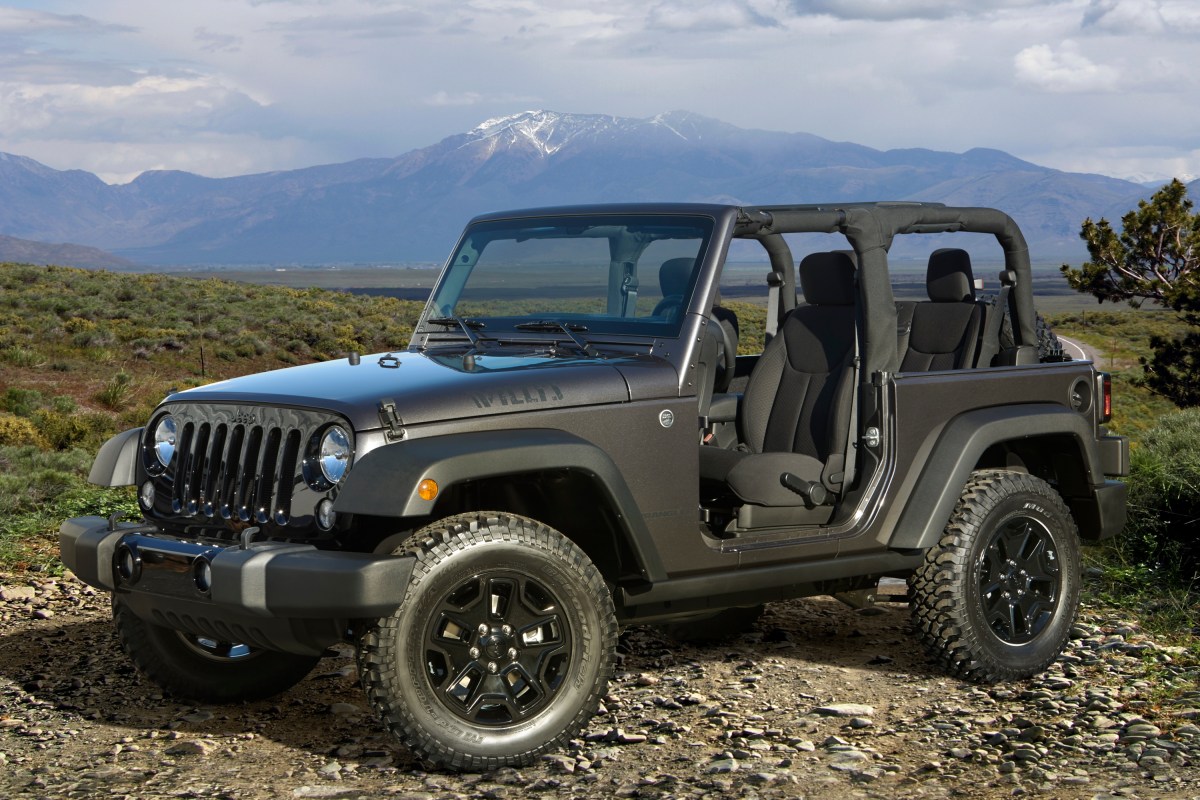
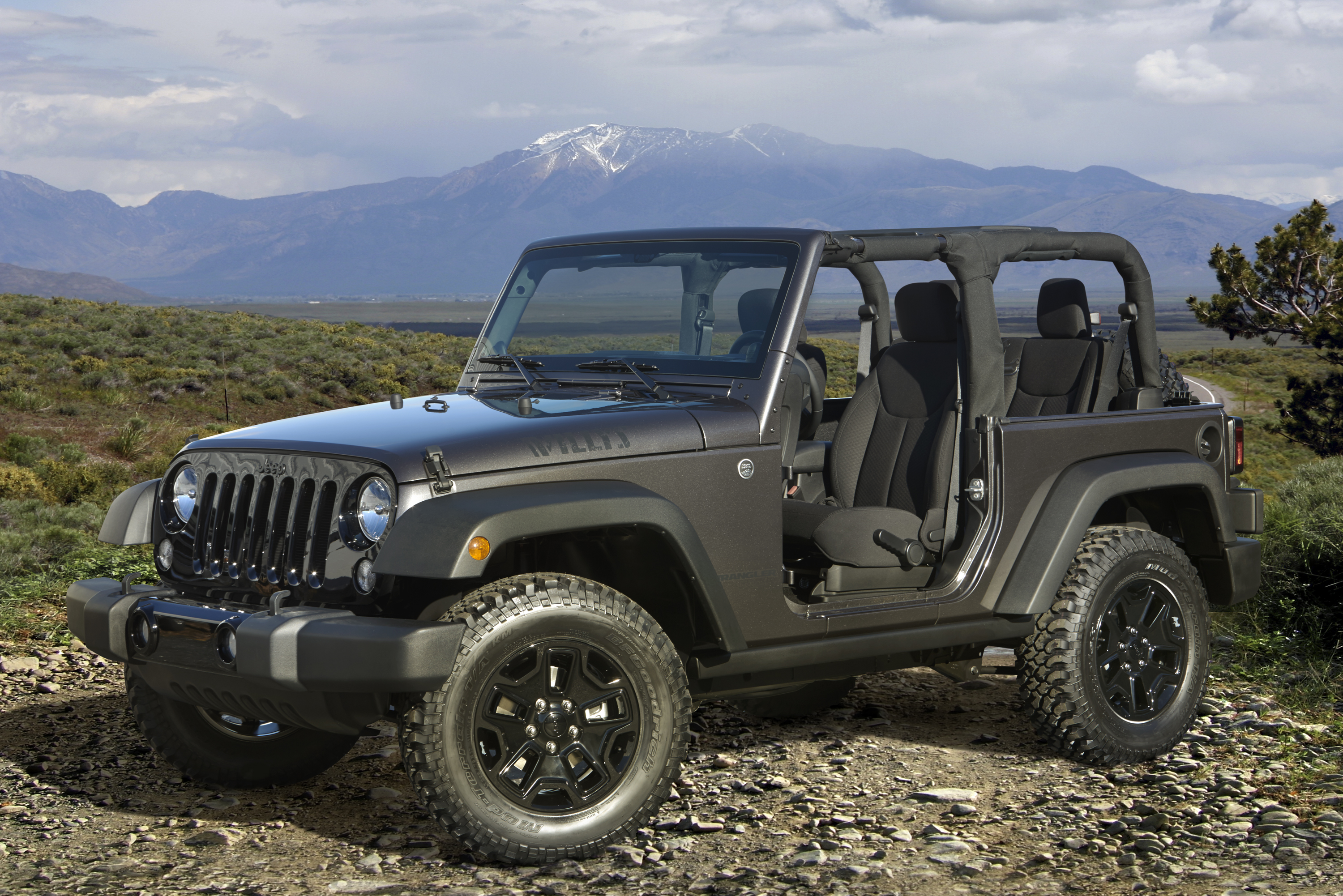
2014 Jeep Wrangler Willys Wheeler Edition
Jeep has further advanced the Wrangler line with the new Willys Wheeler edition. It maintains it’s classic Jeep-ness with some stylish touches that recall the vehicle’s WWII heritage.

In an automotive world of increasingly high-tech cars and SUVs, it’s good to know that the back-to-basics Jeep Wrangler Sport 4×4 still exists.

The 2014 Wrangler Sport comes loaded with some of the high-tech systems drivers have come to expect in current cars and trucks: electronic stability control, traction control, Bluetooth connectivity, tire pressure monitoring system and steering wheel mounted audio controls.

But, that means there are still a quite a few manual controls to remind you that the Jeep hasn’t forgotten its DIY roots. The 6-speed manual transmission is standard (mated to a 3.6 litre V6 engine) as are the manual windows, manual mirrors and fold-away fog lamps. Plus powering the entire thing is a simple key – no proximity-sensing fob that can stay in your pocket as you push a button to start the engine. You use a key to lock and unlock the doors then place the key in the ignition, y’know, just like in the old days. If you’re really bothered by having to open the doors, you can just remove them. Then once the soft-top is lowered (it’s standard equipment, but a premium version is a $350 option) you’ll have an authentic Jeep driving experience.

Which is what the longtime Jeep enthusiasts are after, according to parent company, Chrysler–just a few frills, but nothing that will prevent them from enjoying the feeling of the open road.
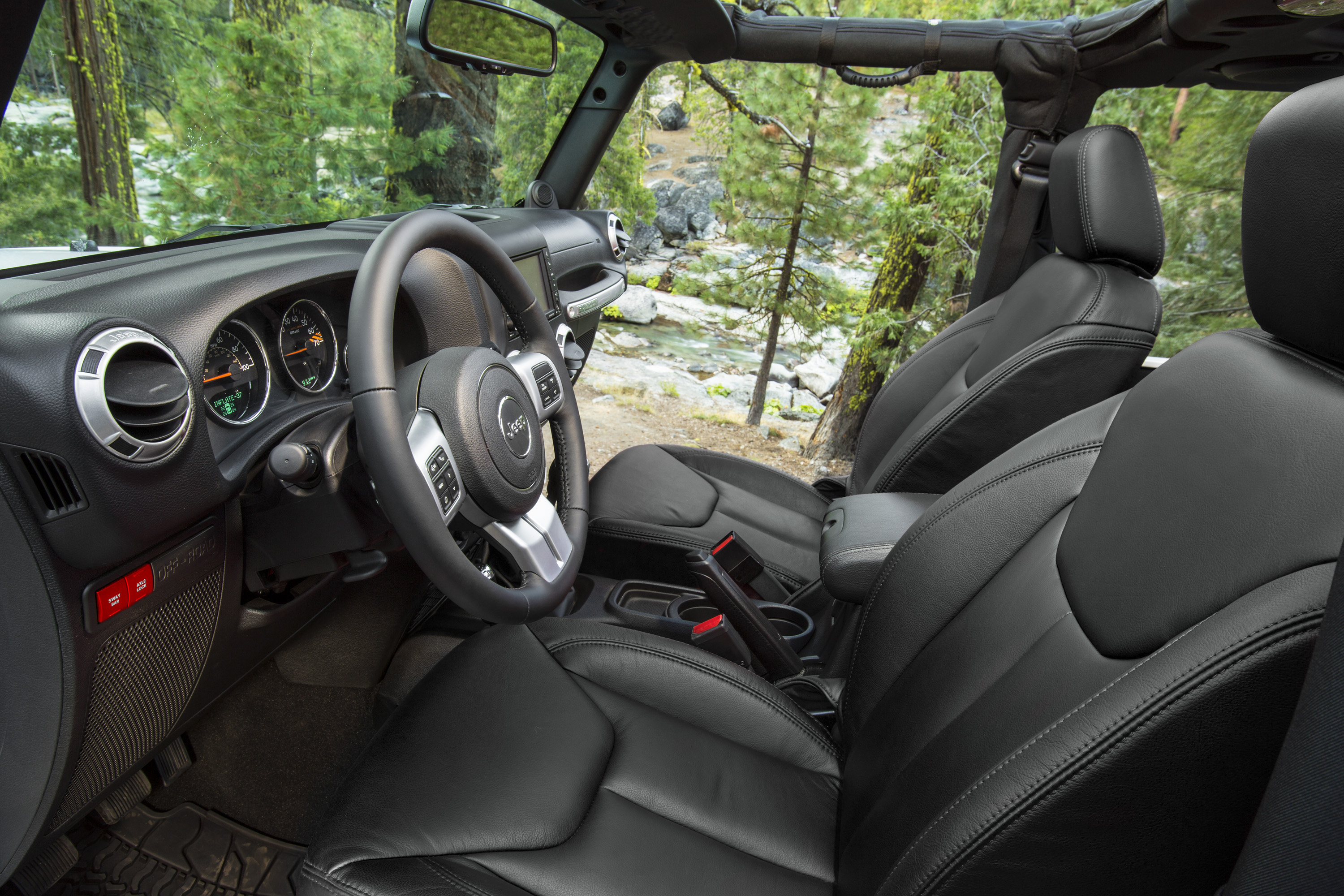
Classic interior style appeals to Jeep purists

On the open road the Wrangler Sport performs well. Its relatively short wheelbase and offroad-ready suspension means you’ll feel a few more bumps in the road than you would in a typical car, but you should expect that in a Jeep. The V6 is powerful if a bit loud, but not that thirsty – my week’s drive on a combination of city streets and highways netted fuel economy of 12 litres/100 km. Not bad for a vehicle with the aerodynamic qualities of a brick. On the highway, the Jeep feels solid and centred. Driver and passenger seats are comfortable and allow for a good view of the road, but the rear seats are a bit cramped. The dash and console layout are straightforward but all controls are easy to find and use. The six-speaker audio system was a particularly great feature. Two of the speakers are located in the crossbar above the driver and passenger seats, respectively, allowing for quality sound even when the top is down.

It’s a small perk but it shows that Jeep knows what its owners will place a premium on.

The soft-top means that exterior road noise is more pronounced than on a typical car but it wasn’t as noisy as I expected. The multi-step process to lower the soft top and remove and store the rear side windows was a bit confusing at first, but gets easy after the first attempt.

All this for just under $30,000 (the review model I drove was priced at $29,970, before taxes). Less than many SUVs and performance cars and a relatively small price to pay for the ultimate summer vehicle.

Originally published on caamagazine.ca Aug. 27, 2014


Categories
Auto industry Cars Driving Reviews Safety Technology

2014 Jeep Grand Cherokee review

My review of the 2014 Grand Cherokee, from the spring 2014 issue of CAA Magazine. This was one of my favourite cars of the bunch I’ve driven over the last few months. It’s a big machine that doesn’t feel big from the behind the wheel. As well, my daughter and wife (also known as the usual passengers) loved the heated seats, entertainment system and panoramic sunroof.

2014 Jeep Grand Cherokee Review

Categories
Auto industry Auto shows Branding Cars Driving

The $250,000 Muscle Car Mashup

At first glance, the Equus Automotive Bass 770 looks like a macho mixture of a 60s Dodge Challenger and a Ford Mustang with a touch of Ferrari thrown in for good measure — and that’s exactly the point, according to Ian James, the boutique car company’s “brand ambassador” (and a race-car driver who was at the wheel for this promotional video.)

James introduced the company to a small group of journalists in Detroit at the North American International Auto Show. The Bass 770 (pronounced “base” because that’s the deep throaty sound the 770 horsepower V8 makes) is built by hand in Rochester Hills, an affluent city not far from Detroit. Production is set to start soon and the company plans to make 100 cars a year, each available for US$250,000.

Equus is owned by a “European businessman” whom James says wishes to remain anonymous. He politely refused to divulge any further details — despite repeated questions and reporters who came at the question from different angles — saying only that the businessman was bankrolling the whole thing and wanted to keep his identity hidden. Journalists were skeptical and James seemed mildly amused, repeatedly saying that yes, the businessman truly does exist; the car is truly about to go into production, at an actual facility. He even gave out the address: 2094 Bond St.

“There’s one owner. There’s no management by committee. That’s why we’ve been able to move fast,” said James.

The Bass 770 is aimed at “high net worth” people in Asia, Europe and the Middle East with a taste for American muscle cars; the kind of person “who wants the best and wants to be seen in the car.” That’s why it has borrowed design elements from Plymouth, Dodge and Ford and combined them on one vehicle, with an engine made by General Motors.

As well, the Equus logo is a galloping horse with shades of both Ferrari and Mustang and Equus itself is the name of a luxury car produced by Hyundai. James maintains despite all that the company hasn’t stepped on any of their competitors’ toes, insisting that the car has its own distinct style. “The styling looks different to everybody,” James said.

Categories
Auto industry Auto shows Branding Cars Content Marketing

Stealing the show

A version of this post appeared on the Totem Brand Stories blog

For the automotive world, winter typically means two things: driving in snow and auto show season.  While the cars are always the stars, the shows themselves are almost as competitive.

The Los Angeles Auto Show kicks off the season in late November, followed by the North American International Auto Show in Detroit (on now, the media preview was last week) with the Montreal Auto Show muscling into the spotlight and running concurrently with the Detroit show. Toronto gets its turn February 15 – 24 when the Canadian International Auto Show marks its 40th annual year.

Despite the Motor City’s struggles and the former Big 3’s troubles, horsepower and sex appeal are still a big part of any auto show.  This year was no exception in Detroit, thanks to the unveiling of the 2014 Chevrolet Corvette Stingray, a 450-hp beast that is loaded with an array of futuristic technology.

But, while the Corvette and other performance cars like the Acura NSX and the Hyundai HCD-14 concept car got the lion’s share of attention, there were two reveals in Detroit that truly reflect consumer tastes.

Honda’s Urban SUV concept and Nissan’s Resonance concept point to a growing and key competitive market for most car companies: the compact SUV – also known as a crossover, or my favourite descriptor: trucklet.

Take a look at the driveways on your street or in any mall parking lot and you’re bound to notice the many Toyota RAV 4s, Honda CR-Vs and Ford Escapes. Each of these vehicles combine car-like handling with varying degrees of truck-like utility, making them useful for hauling around kids and dogs and groceries. Equipped with four-wheel drive, they can also prove handy in a snowstorm. Plus, that 4×4 capability gives them a touch of attitude that you just can’t get from a minivan, even though the minivan is truly the perfect vehicle for hauling kids and dogs and groceries. That’s just one reason why crossovers are so popular – automakers know that we consumers don’t always buy cars for the most practical reasons.

Crossovers have an interesting lineage. The sport utility vehicle boom was led by the Ford Explorer and Jeep Grand Cherokee – both big, brawny, thirsty machines. Gradually the SUV segment expanded into smaller vehicles that have nearly come full circle back to being cars again, and many look like long lost descendants of the old station wagons that pre-dated the SUV boom in the first place. Two key examples are the Subaru Forester and the redesigned 2013 Nissan Pathfinder.

Honda and Nissan believe this segment still has legs (er, wheels) and are aiming the Resonance and the Urban SUV concept (one assumes it’ll have a catchier name when it hits production) at young city dwellers. Honda’s machine will be smaller than the CR-V but not quite as small as its subcompact Fit “making it the ideal size for navigating both crowded city streets and open mountain roads,” says Honda.

The Resonance, assuming it makes production, will carry five people and be powered by a hybrid electric drivetrain. Hybrid and other alternative powertrains are important as automakers look for ways to win over urban consumers and meet government fuel economy standards.

Many of us like to think we’re more Corvette than Caravan when it comes to our choice of vehicle. But small trucklets could actually be one instance where automakers’ need to sell more small, fuel efficient cars might align with our desire to look cool while we ponder heading off on the road less travelled.

Categories
Auto industry Cars Transportation

The cars that drove the culture

This book review appears in the Winter 2012 edition of CAA Magazine

Engines of Change-A History of the American Dream in Fifteen Cars

Engines of Change (Simon & Schuster, 2012) by Paul Ingrassia is a fascinating look at the intersection of cars and culture. And it’s as much about the ground-breaking cars of the 20th century as it is about the people who championed and built them, like Lee Iacocca and Hal Sperlich

In 1961 Iacocca, the relentless marketing man, tapped into the fast-growing “youth movement” and found that young Americans were hungry for a small, fast, sporty car. He and Sperlich, an ambitious product planner, led the teams that took the chassis of the dowdy Ford Falcon and gave it a modern sleek body, creating the Mustang. The car personified youthful optimism and ushered in the Pony Car movement and Detroit’s horsepower wars.

Iacocca and Sperlich were both eventually fired from Ford and found their way to Chrysler in the ’70s. As Iacocca fought to save Chrysler from collapse, Sperlich saw potential profits in a new type of family vehicle: the minivan. He bet that the young people who had bought Mustangs in the ’60s now had families and needed a more practical vehicle. Ford had already rejected Sperlich’s idea, but Chrysler had little to lose. And they had a front-wheel-drive platform that begat the dull but successful K-car, which in turn would underpin the Dodge Caravan when it debuted in 1983.

Engines of Change is full of great stories and anecdotes—from Honda’s audacious entry into North America to Jeep’s many near-death experiences. Even the most oil-stained car enthusiast will be entertained for hours.

Paul Ferriss

 
Categories
Auto racing Cars Driving Touring Cars

Anis, Sharpe and Wittmer: 2012 Canadian Touring Car champs

Michel Sallenbach (left) and Damon Sharpe duel at Calabogie Motorsports Park

 Published in Globe Drive, Sept. 8, 2012

While two class champions had already been crowned, it took until the final Labour Day race weekend of the 2012 Canadian Touring Car Championship season to decide the Touring class champion.

When the checkered flag flew on Sunday, Sept. 2, it was Damon Sharpe in a Honda Civic Si who won the final two races of the season at Calabogie Motorsports Park near Ottawa and took the Touring class championship, defeating his closest rival Michel Sallenbach of Roxton Pond, Que., in a Mini Cooper.

For Sharpe, of Tottenham, Ont., to take two Touring class wins in the final event of the season, as well as the class win in round 14 in Montreal, was vindication for a tough season.

Earlier in the season, “he couldn’t catch a break,” said series president John Bondar. Sharpe had several mechanical problems that were compounded by glitches – as when qualifying times were wiped out at the ICAR circuit due to a technical problem. “He was running well, around fourth spot, but then we had to nullify qualifying times,” said Bondar. “You could just see the disappointment on his face.”

Sharpe’s luck began to turn in Montreal and continued when he hit Calabogie. He started from the pole position and took the lead early. As Sallenbach tried to pass him, he went on to the grass, damaging his suspension and ending his race.

“I am too competitive and I know I blew it all by myself,” Sallenbach said after the race.

All Sharpe then had to do was finish the next race and the class championship would be his. But he wasn’t ready to relax just yet.

“Guys were coming up and congratulating me and I said, ‘Whoa, I still have to finish the race,’ ” said Sharpe. “Anything can happen in CTCC. The starts alone can be pretty brutal.”

He again started from the pole for the final race but then “dropped back to fourth and started to make some mistakes. I got on to the grass and got all crossed up and had to tell myself, okay, get the mistakes out of the way.” His crew told him he could take it easy and run a conservative race, but “I guess I’m not wired that way.” Sharpe went on to take the Touring class win in his first full season in the CTCC.

In Super Class, Sasha Anis of Mississauga, Ont., drove his Hyundai Genesis coupe to top spot with 1,765 points and Nick Wittmer of Vaudreuil-Dorion, Que,. was crowned B-Spec class champion with 1,404 points in his Honda Fit. Sharpe ended his season with 1,578 points.

The Canadian Touring Car Championship season began in May during the Victoria Day weekend at the Canadian Tire Motorsport Park track near Bowmanville, Ont. Drivers competed in two races in each of the eight race weekends, and the CTCC also made stops at Mont-Tremblant; as support races for the Formula One event and the NASCAR Nationwide race at Circuit-Gilles Villeneuve in Montreal before ending the season at Calabogie.

Racers are divided into three classes: the entry-level B-Spec Class features compact cars, such as the Fit and Mazda2, with stock engines; the Touring class features cars such as the Mini Cooper and Honda Civic Si with minimal modifications; while Super Class machines such as the BMW 330i and Acura RSX have powerful and heavily modified engines and advanced aerodynamics. All three classes compete at the same time on each track.

Anis dominated the season in Super class, with 15 podiums in 16 races. After a dismal season in 2011, he was primed for success in 2012.

“This was the year when everything fell into place,” he said. “The goal for Calabogie was to lead every lap and that’s what we did.” Even when Luc Lesage pushed Anis sideways early in the final race, Anis was able to hold on. “I was thinking, ‘Well, this is how my race is going to end.’ ”

Anis joked that his crew chief, Andrew Stittle, might be a good luck charm for both he and Sharpe. In addition to his crew chief role, Stittle took on the job of driving Sharpe’s transporter. Then the Tottenham driver’s luck took a turn for the better and he started to win races.

Bondar was pleased with the performance of both Anis and Sharpe.

“Sasha kind of drove away from all the other guys. There might be some jealousy but the other drivers respect him. He never does anything dumb on the track. He’s a great champion.

“Damon is an example of just a great battle back.”

For Bondar, highlights of the 2012 CTCC season include the series’ first night race at Trois-Rivieres, Que., in August and taking part in the Formula One weekend in Montreal in June. “We had some great track times for the F1 event – nothing at 8 a.m. or 6 p.m. – all of it was in front of the crowds,” he said. That weekend was capped off with a spectacular crash by Andre Rapone, which saw his B-Spec Mini Cooper launch itself off a curb, across the track and into a wall. Rapone was unhurt, but the in-car video of his crash has so far notched up more than 5,000 views on YouTube.

The series is also enjoying some more conventional video exposure through P1, a reality-based TV show on the CTCC and its drivers that airs on Sportsnet and will run until the end of 2012, and possibly into next season.

Categories
Auto racing Cars Driving Formula 1 NASCAR Touring Cars

Canadian Touring Car Championship gets F1, NASCAR spotlights

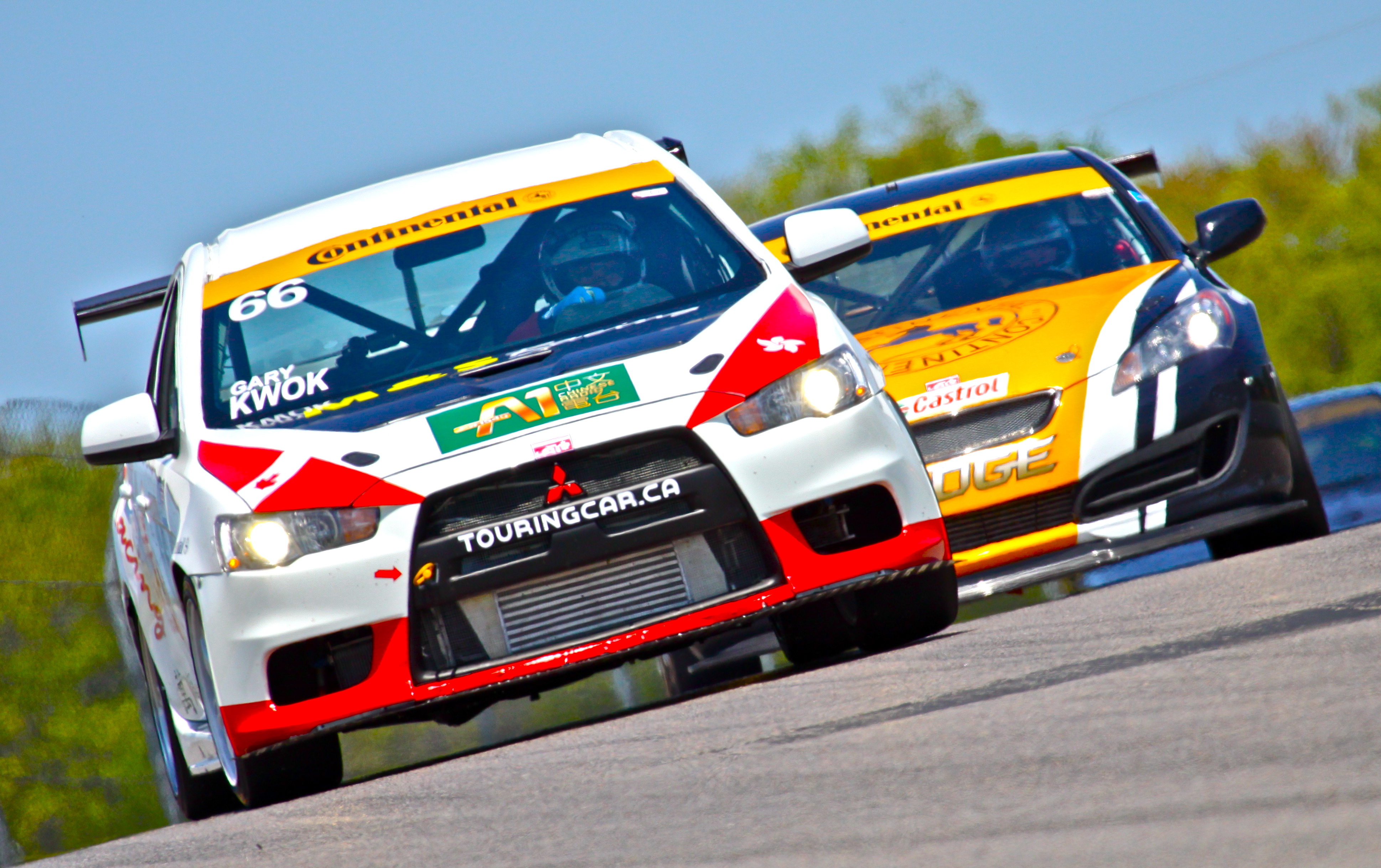
Gary Kwok and Bob Attrell duel during the Victoria Day Speedfest at Mosport International Raceway

Published in Globe Drive on July 4, 2012

For the 2012 season, Canadian Touring Car Championship drivers have forsaken IndyCar in favour of NASCAR and Formula 1.

Series president John Bondar says “scheduling difficulties” prevented the series from competing in a supporting role at the Honda Indy Toronto. But those difficulties meant that the mix of amateur and semi-pro drivers will have competed twice on Circuit-Gilles Villeneuve in Montreal by the end of the season – as a supporting event during the Formula 1 weekend in June and in the upcoming NASCAR Nationwide series weekend August 16 to 18.

Driver Damon Sharpe summed up the racers’ feelings about competing before an F1 crowd just prior to the race: “There is so much history here over the years and everyone just wants to do well here.”

Plus, they’ll head for the first time to the Circuit Mont Tremblant in Quebec on July 6-8. The eight-event season, with two races at each event, began May 18-20 at the Canadian Tire Motorsport Park near Bowmanville, Ont., and ends at Calabogie Motorsport Park, near Ottawa, Sept. 1-2.

Going into Mont Tremblant, Sasha Anis of Mississauga, Ont., leads the Super class with 671 points in his G1 Racing Hyundai Genesis Coupe, followed by Philip Fayer in a Pontiac Solstice with 576 points and Anis’s G1 teammate Jonathan Rashleigh with 516 points. Atop the Touring standings sits Michel Sallenbach of Roxton Pond, Que., and his Mini Cooper S JCW with 664 points followed by Jocelyn Fecteau of Mont St-Gregoire, Que., in a Scion tC with 550 points and Paul Gravel of St-Guillaume, Que., Sallenbach’s teammate, with 536 points.

Anis credits consistent driving and a bit of luck for putting him at the top of the Super class standings. He was helped by two race wins at the ICAR circuit near Montreal on June 23 and 24 and he notched two second places in the season’s first two races at Bowmanville, then a pair of thirds during the Formula 1 weekend in Montreal. But he’s more concerned about maintaining that consistency than thinking too much about whether or not he’ll be on the top of the standings at the end of the season.

“The most important thing is winning the races and not worrying about the championship. I’m enjoying the racing,” he said. “My luck has changed this year and we have a really good car. If we’re running well and we drive well and win the championship, then great.”

Bad luck and mechanical gremlins plagued Anis last season –from being hit and spun out during a race at ICAR, to having a tie rod break and hitting the wall at Bowmanville. Then there was a turbo failure and a differential that fell off his car. “It was some really weird, crazy stuff,” he said.

Anis also has praise for many of his fellow Super drivers, especially brothers Remy Audette and Mathieu Audette in their Acura RSXs: “They were faster at ICAR and they really pushed me – they’ve got really great cars.”

Trust among drivers is key in any racing series, as drivers get to know each other and respect individual driver’s abilities, which allows them to compete and give each other racing room when necessary. But Anis admits maintaining that level of trust can be a challenge in fields of 37 cars, some driven by part-time racers who don’t compete in every race. Then there’s the crop of rookies to deal with. This year, there are 11 new drivers in the series.

“The first race all the series regulars were trying to figure out what these new guys were all about,” said Bondar. “But so far, so good.”

Some of those new guys (and at least one woman, Valerie Limoges of Shawinigan, Que.) are competing in the new B-spec class, an entry level class for subcompact cars like the Mazda2 and the Honda Fit. While Super class cars are heavily modified with advanced aerodynamics and Touring cars have some limited modifications, the B-spec cars are nearly showroom stock racers.

“They’re really low-modification, 98-101 horsepower puddle jumpers, ” said Bondar, who created the class as a low-cost entry point for new racers. The cars require safety modifications (such as a roll cage) and an aftermarket suspension kit, which runs about $2,500. “You can just bolt that on and go racing,” he said. “At the very top end, you could only expect to spend about $10,000.”

The B-spec class has proven unexpectedly competitive. The 2009 and 2010 Super class champ Nick Wittmer, of Vaudreuil-Dorion, Que. leads the B-spec pack with 694 points, followed by Simon Dion-Viens of St. Joseph de Kamouraska, Que., with 643 points and Greg Pootmans of Toronto with 437 points. All are driving Honda Fits.

Bondar admits having a former champion potentially run away with the B-spec class wasn’t the intention of the class when it was created. But, he’s pleased that it can showcase the skills of a driver like Wittmer.

“It’s all skill – he really knows how to drive. He brakes deeper and carries more speed into the corners, then he’s faster on the entrance and exits. He really is putting on a driving school.”

Categories
Cars Driving Fuel efficiency Technology

Toronto Star story on fuel-efficient driving

A piece I wrote for the Star’s Wheels section in my role as CAA Magazine editor. It was published on the web Feb. 24 and in print Feb. 25, 2012

PAUL FERRISS
EDITOR, CAA MAGAZINE

If you’re like most drivers, you’re probably wondering how to reconcile your love of the open road with your concern for the environment.

Thanks to a combination of automotive innovation, good driving habits and some old-fashioned common sense, you can enjoy the drive and worry less about its effect on the world around you.

And while you might be in the market for a hybrid Toyota Prius or a fully electric car, like the Nissan Leaf or Chevrolet Volt, know that you can still get some positive environmental mileage out of the ordinary internal-combustion machine parked in your driveway.

One of the best things you can do for any car is maintain it. Yep, it’s as simple as following your owner’s manual, checking fluid levels once a month, changing the oil at the required intervals and overall making sure everything is running as it should be — or taking it to an auto service technician when you think it isn’t.

“A poorly maintained vehicle may consume more fuel,” says Stephen Akehurst, chief, ecoENERGY Efficiency for Vehicles Program at NRCan (Natural Resources Canada).

“Poor maintenance adversely affects performance, produces higher levels of emissions and often leads to expensive repairs and low resale value.”

According to research from Desrosiers Automotive Consultants, the average age of vehicles on Canadian roads is increasing, so it only makes sense to make sure all the money we’re putting into them has some benefit for us as well as the environment.

While you’re at it, don’t neglect tires. Under-inflated tires increase rolling resistance and will negatively affect fuel efficiency. They’ll also wear faster.

“Tire pressure is a big one,” says Teresa Di Felice, director of government and community relations at CAA South Central Ontario. “That, and proper maintenance, is really important.”

Before you head out on the road, take a look at what’s inside your car, van or SUV. In addition to the important things like kids, dog, hockey equipment or groceries, you might find that a lot of extra, unnecessary stuff has accumulated inside your vehicle.

Or, you might be driving around with an empty bike or roof rack.

Remove any excess items and only install racks when you need them. The more weight you’re driving around with, the more fuel your car’s engine is going to burn.

When you do get behind the wheel, don’t just hit the gas and go — no jackrabbit starts followed by hard braking.

“The harder you accelerate, the more fuel you use,” says NRCan’s Akehurst. “In the city, where about half of the fuel you consume is used to accelerate your vehicle, you can save as much as 15 per cent by pressing the pedal gently. Imagine an open cup of coffee on your dashboard: don’t spill it!”

But don’t idle, either. Thirty seconds is about all your car needs before the engine and fuel is warmed up enough for you to get moving. And, except when you’re stuck in traffic, don’t let your car idle for extended periods. If you’re going to be stopped for more than 60 seconds, shut off the engine.

Once you get onto the highway, it’s best to maintain a constant speed of about 90 km/h. “We always say watch your speed, not just because it’s the law,” says Di Felice. “The prime highway speed is about 90 km/h; once you get above that, you’re really increasing your fuel consumption.”

On the highway, cruise control helps too, as it keeps your vehicle at a constant speed. Just remember to be aware that cruising at 70 km/h while cars around are moving at 90 km/h is unsafe.

Along with arming yourself with some DIY tips on eco-driving, it helps to use some forethought and plan your driving trips in advance, especially if you have several errands to run.

“Plan your trips accordingly, and consider if any of them are walkable or somewhere you can bicycle to,” advises CAA’s Di Felice.

“By decreasing the number of trips you take, you’re obviously reducing your fuel consumption.”

For more eco-driving tips, visit http://www.caasco.com/community/autogreen/eco-driving-tips.jsp or http://oee.nrcan.gc.ca/transportation/personal/15864

Categories
Auto industry Cars Driving Reviews

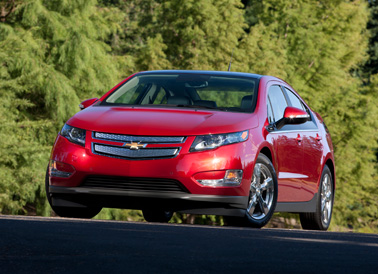
2012 Chevrolet Volt Review

Although it could be the way of the future, there’s something odd about plugging in your car. It’s like having a giant cellphone parked in your driveway, powering up. And that’s the biggest mental hurdle you need to leap when you drive a Chevrolet Volt—the way you’ve fuelled up your car since you got your driver’s license isn’t the way this machine works. Electricity is its prime propulsion method, not gasoline.

2012 Chevrolet Volt

When I first picked up the Volt from a Toronto GM dealer, I was told it was charged up and ready to go. When I got in the car, however, it was down to 20 km range on the battery (with another 360 km range in the supplemental 1.4-litre gasoline-powered engine.) After a couple stops, I was down to about 12 km on the battery.

So, on my way home, I watched as the kilometres slowly ticked down on the battery display on the dashboard. There were no warning lights or alarm bells, just a matter-of-fact ticking down of numbers, 3, 2, 1 … and then, nothing. Seamlessly, the gasoline motor kicked in and the Volt and I kept moving. Had I not been watching the dashboard display I wouldn’t have noticed much except for a change in the engine note. Once the gasoline engine started it went from being nearly silent to sounding a like a small four-banger.

Once I got home, I parked the Volt for a while and then later took it out on a few more short trips, at first feeling somewhat guilty for driving an electric car on a normal 20th century internal combustion engine. That’s when I realized what sets the Volt apart from gas/electric hybrids: the Volt’s gasoline engine doesn’t drive the wheels, it instead uses a small amount of gasoline to create electricity to keep the car going.

When I plugged it in later that evening, it took about 12 hours to fully charge via a regular 120-volt household outlet (it doesn’t have to be fully depleted before being charged up). That’s not bad, but ideally GM engineers will work to reduce that time. GM does offer an optional 240-volt recharging unit that its says can charge the car in four hours. GM also claims that the Volt can run from 40 to 80 km on battery power alone, depending on cargo and outside temperature. My review model needed charging after just under 40 km following a single day of city driving.

During those drives, however, several people stopped to admire the car, which, to GM’s credit, is a handsome machine. It’s also a cleverly designed hatchback that doesn’t look like a typical hatch. Four people can sit comfortably in front and rear bucket seats—the battery stack runs up the centre of the car, taking up some foot room and dividing the four seats. But there’s also a substantial cargo area behind the rear seats. The sloping front windshield and large rear window also provide excellent visibility. The console touch screen works well but some of the touch controls on the console can be tricky unless you hit them exactly right.

Driving the Volt is a futuristic experience. Here’s hoping GM will be able to tweak the Volt’s battery to make that experience last longer.

This review originally appeared on caamagazine.ca

Categories
Auto industry Branding Cars Driving Reviews Technology

2012 Nissan Juke Review

The 2012 Nissan Juke crosses several automotive categories

The Nissan Juke is a true crossover. At first glance it looks like a sporty, two-door coupe—until you notice the nearly hidden rear door handles. It also has the deep wheel wells and tall profile of a small, Jeep Wrangler-like SUV. And that’s the point. The Juke crosses over different car categories (compact car, crossover/SUV, sports car) to create an almost entirely new style of vehicle.

The base model SV with front-wheel drive is priced at $19,998. The Juke version I drove was the AWD model, which starts at $26,778. All four trim lines are equipped with a CVT (continuously variable transmission). Unlike CVTs on some other cars, the Juke’s is quiet and doesn’t drone at higher speeds. The 1.6-litre, 4-cylinder direct injection gas engine is turbocharged and provides strong acceleration and ample power, even in “Normal” mode. Two other engine modes are available with the push of a button on the centre console, Sport and Eco. In Eco mode, the engine’s power is reduced slightly to maximize fuel economy–perfect for a short daily commute.

The Juke’s exterior design is striking. Four headlights give the impression of two sets of eyes keeping watch on the road. Two of those eyes protrude longitudinally from above the front fenders with two circular lights below. But the design also creates some challenges. The low, sloping roofline that looks great from the outside also makes the back seat feel cramped, as does the way the cabin narrows towards the rear. A child can sit comfortably back there, but an adult would feel cramped on longer rides.

The interior design could use some work too. While the navigation/audio system is easy to learn, its buttons are small and hard to use while wearing gloves. Also, for a car that boasts such a high-tech look and is fitted with an array of toys, why are there no power adjustable seats? It seems odd to use a key fob and a start/stop button; change your driving mode with the push of a button and then resort to using a hand crank to adjust the seat. Speaking of the start/stop button, it’s located in an awkward location behind the windshield wiper stalk, making it hard to access without hunting around for it. Same goes for the switches for the heated seats. They’re located between the front seats in the centre console meaning the driver has to reach down and back to turn them on and off, taking their eyes off the road while doing so.

The rear backup camera (standard on the SL trim levels) is a great feature, even for a small car like the Juke. The cargo area is small, but is nicely concealed by the cargo cover and tinted windows.

Overall, if you’re looking for a family hauler, this isn’t the car for you. But if you’re looking for a small car that’s sporty enough to feel like a sports car with available AWD and the tall stance of a crossover, look closely into the four eyes of the Juke.

(This review was originally published on www.caamagazine.ca 01/27/12)